
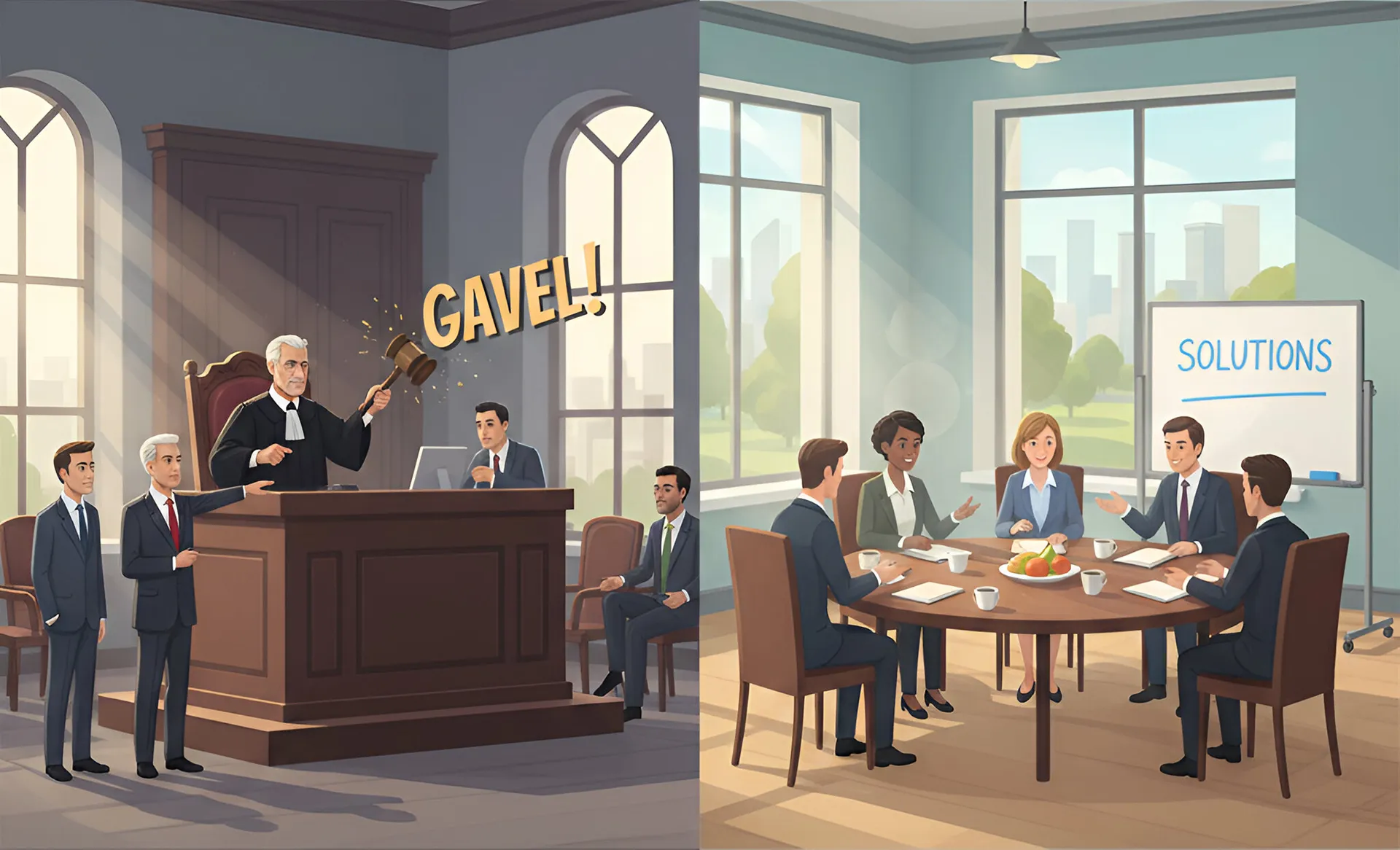
When business disputes arise, owners often face a difficult question: Should we pursue mediation, or is it time to hire a business litigation attorney?
The right choice depends on the nature of the dispute, the relationship between the parties, and how much time, money, and risk the business is prepared to manage.
Understanding the difference between these two approaches—and the advantages and limitations of each—can help you choose a strategy that protects your company and preserves your peace of mind.
Understanding the Core Differences Between Business Mediation and Litigation
Business mediation and litigation are not interchangeable tools; they serve fundamentally different purposes.
Mediation is a voluntary, collaborative, and confidential process guided by a neutral third-party mediator. Rather than deciding who is right or wrong, the mediator helps the parties negotiate a mutually acceptable agreement.
Mediation is typically used for:
- Partnership disputes
- Contract disagreements
- Vendor and supplier conflicts
- Employee/employer misunderstandings
- Client service or payment issues
By contrast, business litigation is a formal legal process where each party hires an attorney to advocate on their behalf. Litigation involves:
- Pleadings and formal discovery
- Motions, hearings, and potential trial
- Court-controlled timelines and outcomes
- Public records and strict procedural rules
Time and cost are major differentiators. Mediation is often completed in a day or a few sessions, while litigation can last months—or even years. Mediation usually costs a fraction of what litigation requires, especially once discovery, expert witnesses, and attorney hours accumulate.
Control also varies greatly.
- In litigation, a judge or jury makes the final decision.
- In mediation, the parties retain full control over the outcome.
Finally, mediation emphasizes preserving relationships—a critical benefit when business partners or long-term clients are involved. Litigation, by its adversarial nature, often damages relationships beyond repair.
If you want help understanding which path fits your dispute, book a free consultation.
Key Advantages of Mediation for Business Disputes
Mediation has become the preferred method of resolving many modern business disputes because it offers several compelling advantages over litigation.
1. Faster Resolution
Most mediations conclude:
- Within a single day, or
- Over two to three short sessions
Compared to litigation—which can stretch 12 to 36 months—mediation drastically reduces downtime and disruption to your business.
2. Far Lower Costs
Litigation expenses accumulate quickly. Attorney fees, court fees, discovery costs, expert witnesses, and delays can make even a small dispute financially burdensome.
Mediation avoids most of those expenses and focuses strictly on the negotiation process.
3. Preserved Business Relationships
Because mediation encourages communication and cooperation, it is especially effective when maintaining the relationship matters:
- Business partners
- Long-term clients
- Vendor/supplier relationships
- Family-owned business disputes
Litigation, by contrast, often creates hostility through depositions, accusations, and combative legal tactics.
4. Confidential and Private
Mediation is not public record.
This protects:
- Trade secrets
- Client lists
- Financial information
- Reputation and brand integrity
Court filings, however, typically become public unless specifically sealed.
5. Greater Flexibility and Creative Solutions
A judge is limited by law when issuing orders.
Mediation allows for customized, business-friendly solutions such as:
- Modified contract terms
- Payment plans
- Adjusted partnership roles
- Mutual releases
- Joint press statements
- Performance improvement agreements
These sorts of outcomes are rarely possible through litigation.
For many companies, mediation is the wisest first step. If you’d like a tailored assessment, book a free consultation today.
When Hiring a Business Litigation Attorney May Be Necessary
While mediation is powerful, it isn’t appropriate for every dispute.
Situations that generally require hiring a business litigation attorney include:
1. Bad-Faith Conduct
If one party has engaged in fraud, misrepresentation, embezzlement, or exploitation, a neutral negotiation environment may not be effective.
2. Complex Legal Issues
Certain cases require legal precedent or judicial authority:
- Intellectual property infringement
- Violations of non-compete or trade secret laws
- Breach of fiduciary duty
- Serious shareholder disputes
3. When the Other Party Refuses to Participate
Mediation requires voluntary cooperation. If the opposing party:
- Refuses to negotiate
- Ignores communication
- Continues violating agreements
…litigation may be the only viable path.
4. The Need for Injunctive Relief
If a business requires a court order—such as stopping someone from competing, stealing clients, or misusing proprietary data—mediation alone cannot provide that protection.
5. Large Financial Stakes
For multimillion-dollar disputes or long-term contractual obligations, legal representation may be critical to protect your rights.
Still, even in these cases, litigation does not always mean mediation is off the table. Many disputes settle during litigation through court-ordered or voluntary mediation, saving time and money.
If you suspect your dispute may require attorney involvement, book a free consultation to understand your legal risks.
How to Decide: Mediation vs. Litigation for Your Business
Choosing the right path starts with asking the right questions:
1. What is your goal?
Do you want compensation, compliance, preservation of a relationship, or simply clarity?
2. Is the relationship worth saving?
If yes, mediation is almost always the better starting point.
3. How urgent is the issue?
Immediate harm (e.g., IP theft) may require litigation.
Negotiation-friendly disputes benefit from mediation.
4. What is the dispute costing your business?
Litigation adds:
- Time loss
- Stress
- Significant financial investment
Mediation resolves issues with fewer resources.
5. Are both parties willing to participate?
Voluntary engagement is essential for successful mediation.
A Hybrid Strategy Works for Most Businesses
Many experts recommend a “mediation first, litigation if necessary” approach.
This strategy:
- Limits costs and conflict
- Helps parties clarify issues
- Often leads to full resolution without court involvement
- Still allows litigation if no agreement is reached
What You Should Do Next
If you’re uncertain which method is right for your situation, the most efficient next step is a personalized case review.
Speak with a neutral dispute-resolution professional to assess:
- Your goals
- The nature of the conflict
- The financial and legal risks
- Which path gives you the best chance of success
You can do that today—book a free consultation.
FAQ: Top Questions People Ask About “Business Mediation”
1. Is mediation legally binding for business disputes?
Yes. Once both parties sign a settlement agreement, it becomes a legally enforceable contract.
2. Is a mediator better than a lawyer for resolving business issues?
For many disputes—especially contractual or relationship-based issues—yes. Mediation is faster, less costly, and more cooperative.
However, lawyers are necessary in complex, high-risk, or bad-faith disputes.
3. How long does business mediation take?
Most mediations resolve within one day or a few short sessions. Litigation often takes months or years.
4. What types of business conflicts can mediation solve?
Mediation can resolve:
- Partnership or shareholder disagreements
- Contract disputes
- Payment issues
- Vendor/client conflicts
- Workplace disputes
- Project performance issues
And more.
5. Do I still need a lawyer if I choose mediation?
Not always. Some businesses bring attorneys for advice; others rely on the mediator alone. You can always hire a lawyer later if needed.